
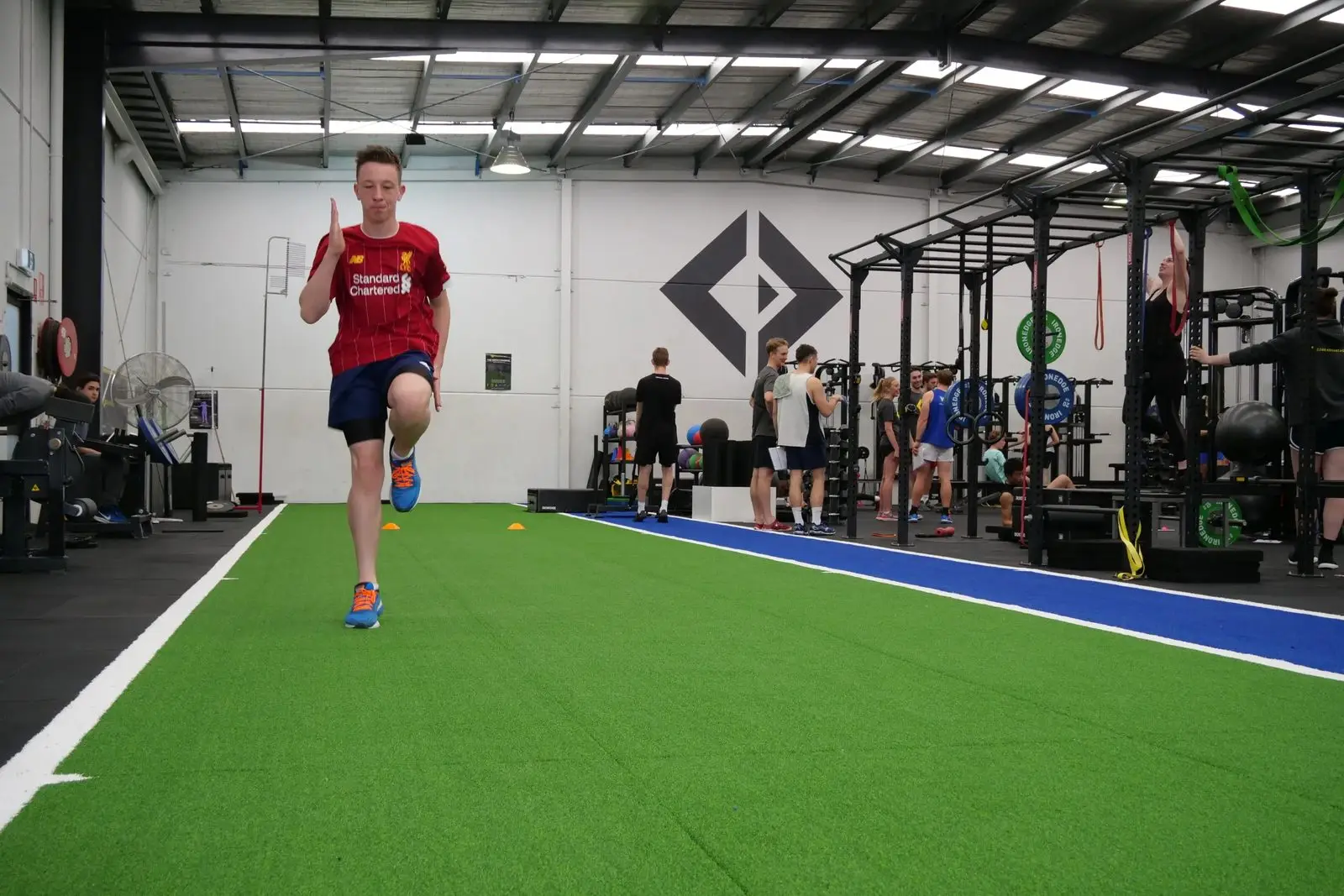
You don't need to be the fittest person in the room to get a good beep test score. You need to be just good enough, and the fastest way there is to stop wasting energy.
The beep test looks like a fitness test, and it is one. But it is just as much a test of running skill, turning and pacing. Most people stop because they have wasted their energy, not because they had none left: sloppy turns, tense running, sprinting ahead and waiting at the line. So we train all four things the test rewards. Fix the free stuff first, then build exactly the fitness you need for the score you're after.
This guide covers every part of it, with videos. Want to know where you're starting from? Run our free beep test audio straight from your phone. Ready to train? Our free 8-week beep test training program builds every workout from your score.
Just good enough: the four things the beep test rewards
- Engine. Your aerobic fitness. It matters, but it is only one part of your score. We build it with level repeats at and just above your score, not endless kilometres.
- Economy. How much energy each stride costs. Relaxed shoulders, quiet arms, quick light feet. An efficient runner uses less fuel at every level, so they reach later levels with more left.
- Turns. By the end of level 10 you have run 94 shuttles and turned at the end of nearly every one. A sloppy turn wastes a little energy every time. Brake late, plant on the line and drive out.
- Pacing. Arrive on the beep, not before it. Sprinting ahead and waiting at the line is stop-start running, the most expensive way to cover 20 metres.
How to turn in the beep test
Every shuttle ends in a 180° turn. Good turns are quick, cheap and the same on both legs. Watch the two videos, then practise them every week.
180° turns
Decelerations
- Brake late and low. Shorten your last two or three steps and sink your hips as you reach the line. Tall and upright into a turn means skidding past it.
- Plant the outside foot on the line. You only need a foot on or over the line. Running a metre past it adds 2 metres to every shuttle.
- Turn your head and shoulders first. Look back down the track as you plant, and your hips follow.
- Drive out short and quick. Push the ground away for the first two or three steps, then settle back into your relaxed stride. (More on this in our two cues for better acceleration.)
- Alternate your turning leg. Plant on your left leg at one end and your right at the other. It shares the load and stops your weaker side becoming the thing that ends your test.
- Round off the slow levels. At the early levels a smooth, rounded turn is fine and costs less. Save the sharp plant-and-drive for when the beeps get tight.
Run relaxed, run efficient
Two athletes with the same fitness will score differently if one runs more efficiently. Every wasted movement costs a little energy at level 3, and that energy is gone when you need it at level 9.
- Run tall with a slight lean from the ankles, not bent at the waist.
- Keep your face, jaw and shoulders relaxed. Tension burns energy you need later.
- Swing your arms forward and back, not across your body.
- Land under your hips on the middle of your foot, with quick, light contacts. Springy, not soggy.
- Settle into a breathing rhythm in the first few levels and keep it.
Effortless running: read the full guide.
Running drills
These are the technique drills in every warm-up of the program: one 20m run of each, at a walk-back recovery. Quality over speed.
Marching
Posture and front-side knee lift without the speed. Tall, tight, rhythmic.
Arm swings
Forward and back from the shoulder, elbows bent, hands loose. Your arms set the rhythm for your legs.
High hip skip
Skip with a tall posture and quick ground contact. Builds the springy, elastic stride you want.
Piston run
Short, fast steps landing under your hips. Teaches you to stop over-striding.
Double-leg springs
Low, quick bounces off the balls of your feet. Stiff ankles, fast contacts: the spring in every stride.
Metronome running
Run to a beat (around 170 to 180 steps per minute) to lock in a quick, efficient cadence.
Arrive on the beep
At level 5 you have 6.86 seconds to run 20 metres. Get there a second early and you ran 17% faster than you needed to. Then you stand still, and have to accelerate from zero again. Do that 40 times and you've paid for a level you never got credit for.
The goal is to touch the line as the beep sounds, turning in one smooth movement and leaving at a steady pace. Runners who time it well hardly change speed all test. Runners who don't are doing intervals.
- Be patient early. Levels 1 to 4 should feel lazy. If they don't, you're going too fast.
- Watch the halfway point. Use a cone or mark at 10m. If you pass it well before halfway between beeps, ease off.
- Practise it. Workout 1 every week includes pacing reps at an easy level so arriving on time becomes automatic. You can loop any level with the level repeats in our beep test audio.
- Got a warning? Don't sprint the whole length. Drive harder out of the next turn, then settle.
How the 8-week program works
Three separate workouts a week for eight weeks, each built from your current beep test level. Do them on different days. Week 8 is a taper and a retest.
- Workout 1: Technique & pacing (easy). Turn practice, then easy pacing reps three levels below your score. Low effort, high skill. It can double as your warm-up before sport training.
- Workout 2: Level repeats (steady). Loop one level for 2 to 4 minutes at a time, with walking rests. Starts two levels below your score and builds to your current level for minutes at a time.
- Workout 3: Speed reps (hard). Short reps at or above your score. Running faster than test pace is what makes test pace feel comfortable.
The same warm-up before every workout
- Crouching Three stretches: 30 seconds each side for the adductor, hip flexor and glute
- 10 glute bridges
- 10 calf raises
- 2 minutes of easy jogging
- 1 × 20m of each technique drill: marching, arm swings, high hip skip, piston run and double-leg springs
Then the day's main set: the working shuttles.
Rules of the program
- Leave at least one day between Workouts 2 and 3. A suggested week: Workout 1 on Monday, Workout 2 on Wednesday, Workout 3 on Saturday.
- Training for a sport or martial art as well? Do Workout 1 as your warm-up before training, and keep Workouts 2 and 3 away from your hardest training days and gradings.
- If you miss beeps or your turns fall apart in a workout, repeat that week before moving on.
- Feeling easy? Stick to the plan anyway. Your retest in week 8 decides your next starting level.
Test day
Arrive fresh. Week 8 halves your volume but keeps the speed, the same approach we use to taper athletes for competition. Fatigue hides fitness. Take an easy day before the test, and eat and sleep as you normally would.
Warm up properly. Easy jogging, your drills, four or five practice turns on each leg and two short runs at your test pace.
Run the early levels lazy. Rounded turns, relaxed shoulders, arrive on the beep. You are banking energy for later.
When it gets hard, shrink the test. Stop thinking about levels and think about one shuttle: get to the next line. Then the next. This is where grit counts, and you have rehearsed it in your step-up reps.
Testing other things too? Run the beep test last, after any jump, sprint or strength tests. Our athletic testing guide explains why.
Train without breaking down
Three running workouts a week with hundreds of turns is real load for your shins, calves and Achilles, especially if you haven't been running much. A sudden jump in running is one of the most common causes of shin splints (more on managing training load).
- New to running? Do only Workouts 1 and 2 in week 1.
- General muscle soreness the next day is normal. Pain in one spot on your shin, Achilles or knee that gets worse as you run is not. Stop, rest and get it checked.
- Run in shoes with grip on a surface that doesn't slip. Most turning injuries are slips.
This program is general information, not individual medical advice. If you have an injury, a medical condition or haven't exercised in a while, check with a health professional before you start.
A sample week: week 1
Every level is written from your current level, C. If your score is 7.5, C is level 7, so C−2 is level 5. In the free program your levels are filled in for you, and the timer plays each main set with beeps and spoken reps, rests and countdowns.
| Workout | Day | After the warm-up |
|---|---|---|
| 1. Technique & pacing Easy | Monday | Turn practice: 6 decelerate-and-turn reps per leg Pacing reps: 3 × 3 min at level C−3, rest 1 min |
| 2. Level repeats Steady | Wednesday | 4 × 2 min at level C−2, rest 1:30 |
| 3. Speed reps Hard | Saturday | 6 × 1 min at level C, rest 1 min |
Weeks 2 to 8 build from here: longer reps one level closer to your score, then minutes at your level, then step-up reps past it, before a taper and a retest. They unlock when you start the free program.
Keep learning
- Repeat sprints for sport-specific fitness: 20m sprint, turn, walk back. A great extra session for team-sport athletes.
- The conditioning continuum: why short, fast intervals carry over to longer efforts like the beep test.
- Game Fit: our shuttle-based preseason session that mimics the demands of a game.
- Effortless running: the running economy basics behind every drill in this guide.
- How to taper: cut volume, keep intensity, arrive at test day fresh.
- Beep test vs Yo-Yo test: how the beep test compares with the Yo-Yo test the pros now use.