
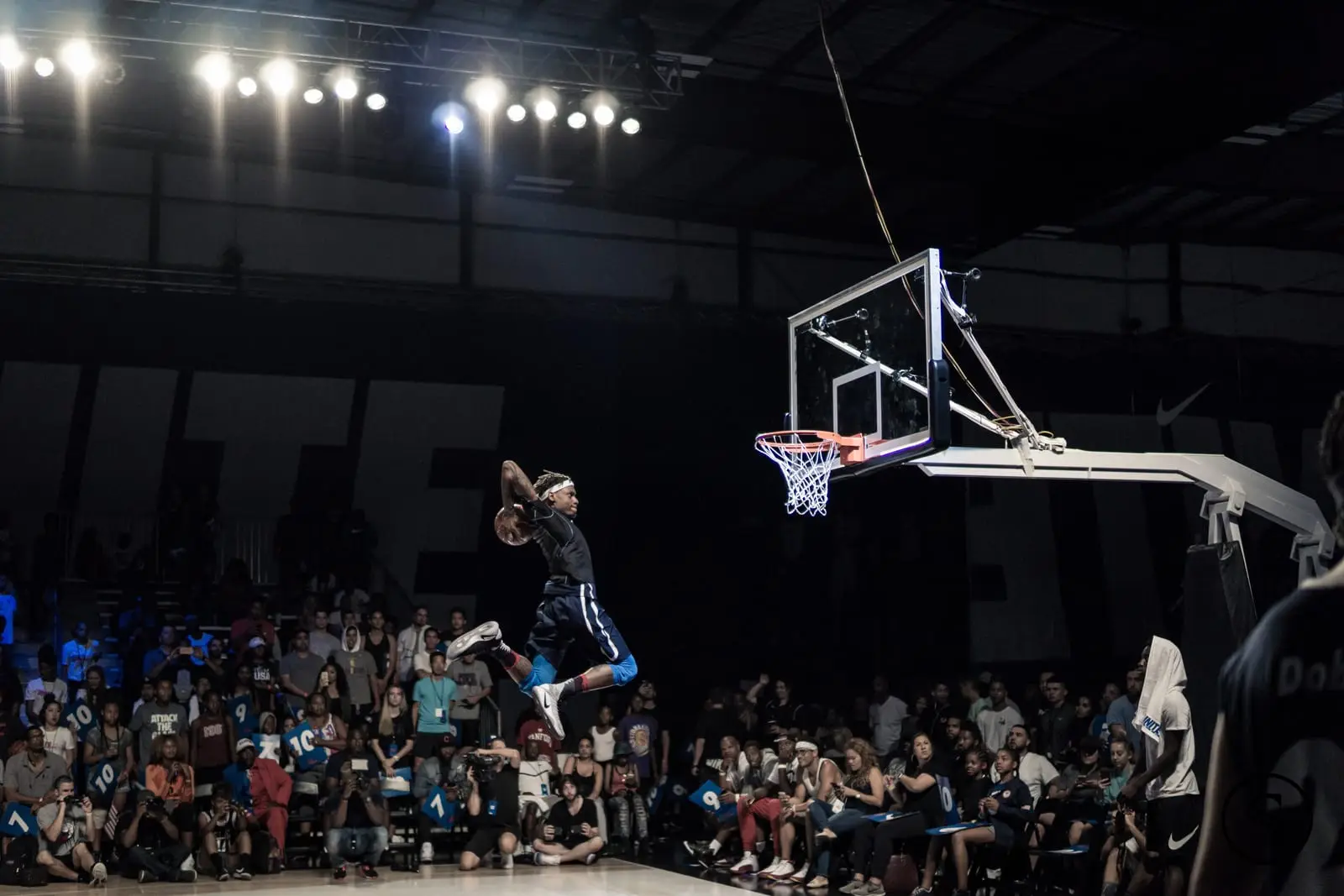
Every basketball player wants the same thing: to get higher. A bigger vertical means finishing over defenders, winning rebounds you have no right to, blocking shots at the rim, and — for a lot of players — finally dunking. But jumping for basketball is not the same as jumping in a lab. The game asks for a specific kind of jump, and training for it beats chasing a generic number.
If you want the underlying science first, start with how to jump higher. This guide is about turning that into hops that show up on the court.
The two jumps basketball actually needs
Basketball is played off both feet, and the two takeoffs are almost different skills:
- One-foot jump. Off a run-up, planting a single foot. This is your layup, your run-up dunk, and most explosive in-game leaps. It rewards speed into the floor and single-leg reactive strength.
- Two-foot jump. Off a gather, both feet planting together. This is your standstill dunk, your rebound and your block under the ring. It rewards raw double-leg power.
Most players are noticeably better at one than the other. The fix is not to only train your strong jump — it is to test both and give the weaker one the attention.
Know your numbers before you train
Three tests tell you almost everything about where your hops are and what to train:
- Two-foot standing jump vs running jump. The gap shows how much your approach and elasticity are adding. A small gap means your run-up technique or spring needs work; a big gap on a low standing jump means raw power is the limiter.
- Single-leg jumps, left vs right. One-foot finishers live on their plant leg. A side-to-side gap over 10% is worth attention — it is height you are leaving on the floor on one side, and it matters double if you have had an ankle or knee injury.
- Reach vs rim. Mark your standing reach, then your best running touch. The distance to the rim (305 cm / 10 ft) is your actual project, in centimetres, not vibes.
The Metric Jump app measures the jumps from your phone — it classifies each jump type automatically, tracks left and right singles separately and reports your symmetry, so you can re-test every few weeks without any equipment. Our guide to testing your vertical covers the full protocol.
Strength: the base every jump sits on
You cannot express power you do not have, and relative strength — strength for every kilo of bodyweight — is the quality most tightly tied to a big vertical. The testing data backs this up. The staples:
- Squats, back or front, through a full range.
- Rear-foot-elevated split squats, which build the single-leg strength a one-foot takeoff lives on.
- Trap-bar deadlifts, loading the hips and posterior chain that drive the jump.
- Calf raises, your last contact with the floor and an easy home win.
Power and plyometrics: strength you can use in a split second
A rebound does not wait for you to grind out a slow jump. Power work teaches you to put force down fast, and plyometrics train the elastic, spring-like stretch-shortening cycle that makes a run-up jump higher than a standing one:
- Jump squats and trap-bar jumps for loaded explosive power.
- Pogo hops for stiff, fast ankles — the single most basketball-specific plyo there is.
- Bounds and broad jumps for horizontal power and landing control.
- Depth jumps, the most demanding option, added only once you are strong and land cleanly.
Plyometrics are hard on the knees, so keep the quality high and the volume low — remember that a week of basketball is already hundreds of jumps, sprints and cuts, which is plyometric load whether you call it that or not. The secret ingredient is intent: every contact should be as fast and violent as you can make it. The full ladder, and how to progress it safely, is in our complete guide to plyometrics.
In-season vs off-season: when to build
You cannot max out vertical training and a full game schedule at the same time. In-season, games and practices supply all the jumping volume your tendons want — so keep one short, heavy strength session a week to hold your gains, do your daily mobility, and skip the extra plyometrics. The off-season is when you build: that is the window for the strength blocks, the loaded power work and the plyometric progressions that actually move your numbers. Players who grind jump programs through the season usually just arrive at finals tired.
The approach: free centimetres most players leave on the floor
The same legs jump higher with a better run-up. A quick penultimate step (the second-to-last step that lets you gather and load), a long, low plant, and a full two-arm swing can add real height with no extra strength at all. Sharpen it with our guide to jumping technique, and do your mobility work so tight hips and ankles are not capping you before you leave the ground.
Can you train it at home?
Yes, and a lot of players have to. Bodyweight strength (squats, split squats, single-leg calf raises), low-equipment plyometrics (pogos, broad jumps, box jumps onto a sturdy surface), and daily mobility will move your vertical without a gym. Add a loaded backpack or a pair of dumbbells once bodyweight stops being a challenge. The principles do not change — only the load does.
What about dunking?
Dunking is not about the jump alone. It is your standing reach plus your running vertical against a 305 cm rim, so a taller player needs less hops than a shorter one. Our complete guide on how to dunk covers the maths, the takeoff styles and the first-dunk progression — and if you are already grazing the rim, the two-week peaking plan is the shortcut. If you are not close yet, the work on this page is how you get there.
The mistakes that keep basketballers grounded
- Max-effort dunk sessions every day. Jumping is training, and daily maximal jumping on top of practice is how tendons break down. Fresh and occasional beats tired and constant.
- Gimmicks over fundamentals. Jump shoes, ankle weights and "add 10 inches in 2 weeks" internet programs are somewhere between useless and dangerous. Nothing on this page is exciting, and that is why it works.
- Long runs for "fitness". Steady-state kilometres push your physiology away from explosive and keep your legs too tired to jump. Condition with the game itself or short repeat sprints instead.
- Training only the strong jump. If you only ever practise your favourite one-foot finish, your two-foot power (and your rebounding and blocking) stays behind. Test both, train the weaker.
A simple weekly plan
Two or three quality sessions beat daily grinding:
- Day 1, strength. Mobility warm-up, squat 4x5, rear-foot-elevated split squat 3x8, calf raises 3x12.
- Day 2, power and plyos. Mobility warm-up, pogo hops 4x10, box jumps 5x3, jump squats 4x3, one-foot bounds 4x3 each leg.
- Day 3, optional. Repeat the strength day heavier, or rest if your legs are not fresh.
Never train plyometrics on sore legs, and test your vertical every few weeks so you can see it moving. If you would rather have every set and progression laid out for you, that is exactly what our jump program does.